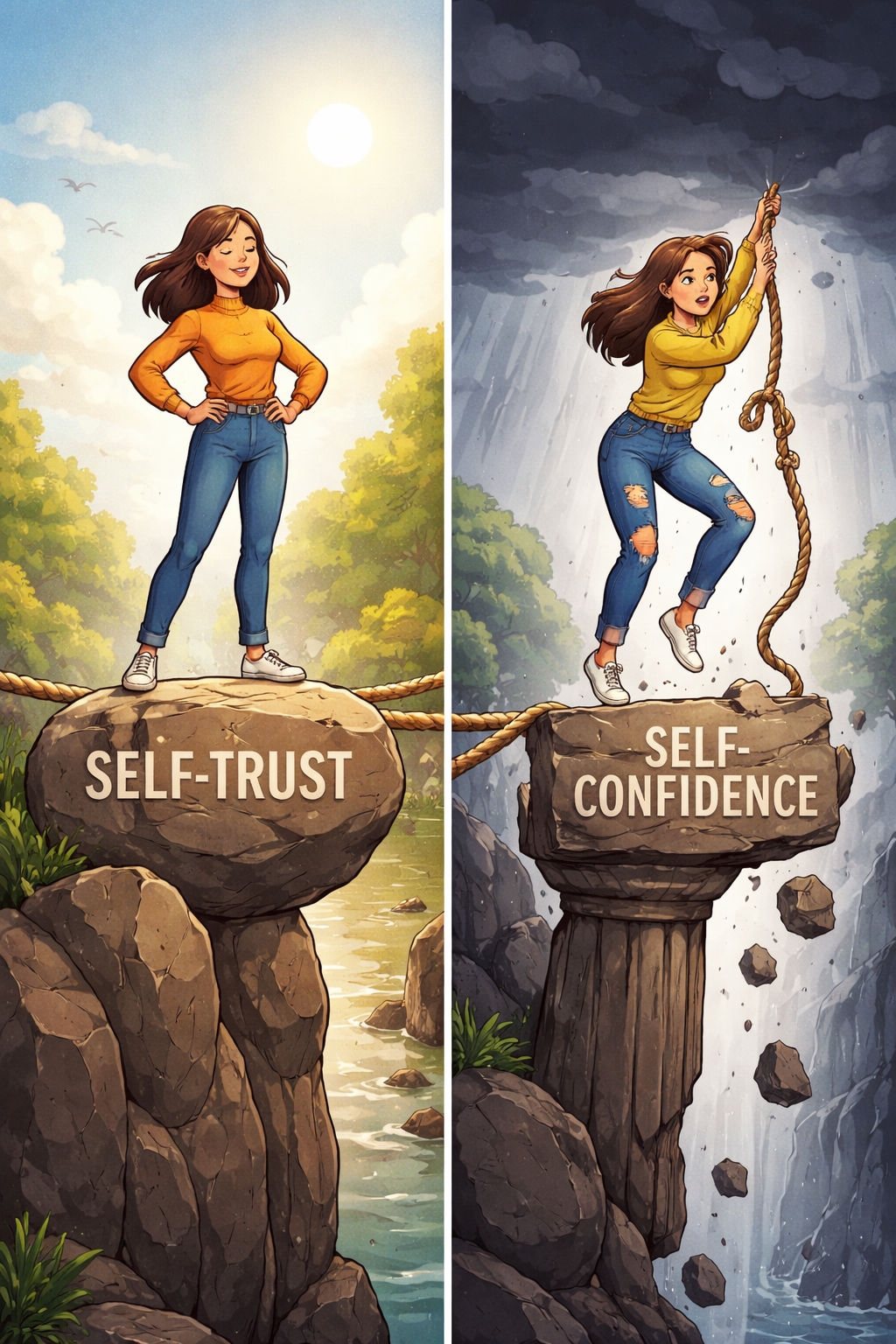
Confidence often gets the spotlight—it looks bold, feels energizing, and draws attention. Yet many people discover that confidence can vanish quickly under pressure, failure, or uncertainty. This contrast is at the heart of self-trust vs self-confidence. One depends on how capable you feel in a moment; the other depends on how deeply you believe you can handle whatever happens next. Understanding this difference changes how you approach growth, resilience, and self-belief.
What’s rarely discussed is how confidence and self trust develop through entirely different experiences. Confidence grows through success, praise, and evidence, while self-trust forms through consistency, honesty, and follow-through—especially when things don’t go well. Confidence asks, Can I perform? Self-trust asks, Can I rely on myself even if I don’t? This distinction becomes critical when external validation disappears or outcomes don’t meet expectations.
This exploration isn’t about choosing one over the other, but recognizing which one sustains you when life becomes unpredictable. Confidence can open doors, but self-trust keeps you standing when those doors close. As explored in Manifestation vs. Motivation: Why Identity Beats Willpower Every Time, lasting resilience grows from identity alignment rather than emotional intensity alone. By understanding how each works—and why one endures—you gain a steadier foundation for progress, decision-making, and inner resilience that doesn’t collapse when certainty fades.
Self-Trust vs Self-Confidence: Why One Survives Pressure While the Other Cracks

Pressure reveals the true foundation beneath belief. In moments of uncertainty, self-trust vs self-confidence becomes less of a concept and more of a lived experience. Confidence often depends on conditions being favorable—clear expectations, positive feedback, predictable outcomes. When those conditions disappear, confidence can fracture. Self-trust, however, isn’t built on how well things are going; it’s built on the expectation that you will stay engaged, adaptive, and honest with yourself no matter what unfolds.
This difference explains why confidence and self trust behave so differently under stress. Confidence asks, Can I succeed here? Self-trust asks, Can I handle whatever happens here? One is performance-based, the other process-based. Under pressure, performance thinking narrows focus and amplifies fear of failure. Process trust widens perspective and keeps movement possible, even when the outcome is unclear. This is why some people continue forward after setbacks while others retreat—not because one is stronger, but because one is more internally anchored.
What ultimately survives pressure is not certainty, but reliability. Self-trust holds because it doesn’t require things to go well in order to continue. It allows for missteps, recalibration, and growth without self-abandonment. When confidence cracks, self-trust remains as a steady presence—quiet, unremarkable, and powerful. In the long run, it’s this inner stability that sustains progress long after confidence has come and gone.
The Quiet Stability That Remains When Confidence Disappears

When confidence disappears, what remains determines how you move forward. In this space, the difference between self-trust vs self-confidence becomes tangible. Confidence fades when external validation, certainty, or success is removed. Self-trust, however, doesn’t rely on those signals. It stays present as a steady inner orientation—one that doesn’t promise success but guarantees engagement. This quiet stability often goes unnoticed because it isn’t loud or energizing, yet it’s what prevents collapse.
The relationship between confidence and self trust becomes clearer during moments of loss, failure, or ambiguity. Confidence wants reassurance; self-trust offers permission. One asks, Am I good enough right now? The other says, I’ll stay with this even if I’m not. This distinction shifts how pressure is experienced. Instead of panic or withdrawal, there’s space to pause, adjust, and continue. Stability comes not from certainty, but from knowing you won’t abandon yourself when things get uncomfortable.
Over time, this quiet stability becomes a reliable foundation. Confidence may return—and it often does—but it’s no longer essential for progress. Decisions feel less reactive, setbacks feel less personal, and growth becomes less dramatic but more durable. When confidence fades, self-trust remains as a calm undercurrent, guiding action without urgency. It is this unseen steadiness that allows momentum to continue long after confidence has come and gone.
Why Confidence Needs Validation—and Self-Trust Doesn’t

Confidence is inherently relational—it grows in response to feedback, results, and reassurance from the outside world. This is why it fluctuates so easily. When praise is present, confidence rises; when criticism or uncertainty appears, it weakens. This dynamic highlights the core difference in self-trust vs self-confidence. Confidence looks outward to confirm worth, while self-trust looks inward to confirm reliability. One asks for proof; the other rests on experience.
This distinction explains why confidence and self trust behave so differently under pressure. Confidence needs validation to feel justified—it wants signs that you’re doing well, that you’re approved, that you’re on the right track. Self-trust doesn’t require those signals because it isn’t tied to outcome. It’s built through consistency, honesty, and the lived evidence that you can handle discomfort, mistakes, and uncertainty without withdrawing from yourself. Where confidence seeks reassurance, self-trust offers permission to continue.
Over time, reliance on validation can become exhausting. When confidence depends on external response, progress slows the moment feedback disappears. Self-trust, however, sustains movement in silence. It allows you to act without applause, adjust without shame, and continue without needing certainty. This is why self-trust outlasts confidence—it doesn’t need to be reinforced constantly. It simply remains, steady and intact, even when no one is watching.
How Self-Trust Is Built in Moments Confidence Can’t Protect You

Self-trust is forged in moments where confidence offers no shield—when outcomes are uncertain, support is absent, and reassurance can’t be found. These are the situations where self-trust vs self-confidence becomes a lived distinction rather than an abstract idea. Confidence thrives when conditions are favorable; self-trust develops when they’re not. Each time you stay present through discomfort, make a grounded decision without guarantees, or continue despite doubt, you reinforce the belief that you can rely on yourself even when things don’t go as planned.
What makes these moments powerful is their emotional honesty. Confidence often depends on feeling capable before acting, but self-trust grows from acting without that feeling. This is where confidence and self trust diverge most clearly. Confidence asks for certainty; self-trust builds tolerance for uncertainty. When you don’t abandon yourself after a mistake, a rejection, or a misstep, you create internal evidence that resilience exists independent of success. That evidence accumulates quietly, without applause.
Over time, these experiences reshape how pressure is handled. Challenges no longer feel like threats to self-worth, but opportunities to reinforce reliability. Self-trust doesn’t eliminate fear or doubt—it coexists with them. And because it’s built in moments confidence can’t protect you, it doesn’t collapse when confidence fades. Instead, it remains as a steady internal anchor, guiding action when certainty is unavailable and strength feels quiet rather than bold.
What Really Carries You Forward After Failure, Doubt, or Setbacks
After failure or setback, what moves you forward is rarely confidence. Confidence often disappears when results disappoint or plans unravel. In these moments, the contrast between self-trust vs self-confidence becomes clear. Confidence waits for evidence that things will work again; self-trust continues without that evidence. It doesn’t promise success—it promises presence. And presence is what allows recovery to begin.
This distinction reshapes how confidence and self trust function during difficulty. Confidence asks, Do I still believe I can win? Self-trust asks, Will I stay with myself while I figure this out? One depends on future outcomes; the other anchors in current commitment. After doubt or loss, that commitment is what allows reflection instead of retreat, adjustment instead of avoidance. It creates space to learn without self-judgment and move without urgency.
Over time, self-trust becomes the quiet force that outlasts both success and failure. It carries you forward when motivation is low, validation is absent, and certainty is unavailable. Confidence may return later—and often does—but progress doesn’t wait for it. When self-trust is present, setbacks no longer signal an end. They become transitions, navigated not by feeling strong, but by staying connected to yourself through whatever comes next.
Conclusion
Confidence and self-belief are often treated as the same, but pressure reveals their differences. Throughout this exploration of self-trust vs self-confidence, a clear pattern emerges: confidence thrives on validation, certainty, and favorable conditions, while self-trust survives without them. When confidence disappears—after failure, doubt, or setbacks—self-trust remains as a quiet stability. It doesn’t depend on feeling capable in the moment; it depends on knowing you will stay engaged, adaptive, and honest with yourself.
This distinction explains why confidence and self trust lead to very different outcomes over time. Confidence cracks when approval fades or results disappoint, but self-trust is built in the moments confidence can’t protect you. It forms when you show up without reassurance, recover without self-blame, and continue without guarantees. These experiences don’t feel impressive, yet they create a deeper reliability that allows progress to continue even in uncertainty.
What ultimately carries you forward is not how confident you feel, but how reliably you relate to yourself when things go wrong. Confidence may return when conditions improve—but self-trust is what ensures you don’t fall apart while waiting. In understanding self-trust vs self-confidence, you gain more than insight; you gain a foundation that holds when everything else feels unstable, allowing growth to continue with steadiness, resilience, and self-respect.
Leave a Reply