
Most people try to change their behavior by changing their mindset, but overlook the silent architect around them: their environment. The connection between environment and habit formation is far deeper than convenience or aesthetics—it is psychological conditioning in action. The spaces you inhabit subtly suggest what is normal, what is easy, and what is rewarded. When you understand how environment influences habits, you begin to see that your daily behavior is not just a matter of discipline, but of design. Your surroundings are constantly cueing you toward certain actions, shaping routines that eventually feel automatic.
To grasp the importance of habit formation, we must examine the mechanics beneath it. The brain links cues, behaviors, and rewards in consistent loops, reinforcing what is repeated. These loops highlight the core characteristics of habit formation: repetition, context, and emotional reinforcement. Over time, the role of habit expands beyond behavior and into identity. The role of habit is not merely to help you perform tasks efficiently—it is to construct patterns that define how you respond to stress, opportunity, and growth. When the environment consistently supports a specific loop, that loop strengthens without conscious effort.
This is why lasting change rarely happens through willpower alone. When you redesign your environment—removing friction for positive actions and increasing friction for negative ones—you are influencing behavior at its root. In many ways, this principle aligns closely with the ideas explored in The Science of Habits: How Small Daily Actions Reprogram Your Subconscious Mind, where the neurological foundations of repetition and cue-based behavior are unpacked. By becoming intentional about your surroundings, you stop fighting your habits and start guiding them. And when your environment supports your growth, transformation becomes less about struggle and more about structure.
Environment and Habit Formation: Why Your Surroundings May Be Deciding Your Future Without You Noticing

Look around you for a moment. What behaviors does your space make easy? What behaviors does it quietly discourage? The relationship between environment and habit formation becomes obvious when you stop focusing on motivation and start observing friction. If your desk invites distraction, distraction becomes routine. If your kitchen counter displays healthy options, better choices require less effort. This is not accidental—it reveals how environment influences habits at a subconscious level. Your surroundings act as silent prompts, steering repetition long before conscious intention steps in.
To understand the deeper consequences, consider the characteristics of habit formation: repetition, cue exposure, and reward association. These elements are not isolated from context; they are strengthened by it. The more frequently you encounter a cue, the more automatic the behavior becomes. Over time, the role of habit shifts from simple routine to behavioral identity. What you repeatedly do in a given environment feels normal, and what feels normal becomes difficult to question. That is why the importance of habit formation cannot be separated from the spaces you occupy. Your environment is not just where habits happen—it is what sustains them.
If your surroundings are influencing your future, then redesign becomes a strategy. Start by identifying one area of your life where your environment contradicts your goals. Then adjust it deliberately. Remove one temptation. Add one visible reminder. Make one positive behavior easier than its alternative. Small environmental edits create disproportionate results because they influence behavior consistently. When you shift the cues around you, you shift the repetition that follows. And when repetition changes, direction changes. Your future is not decided in a single moment—it is shaped quietly by the spaces that shape your habits.
The Invisible Architecture of Influence: How Your Space Quietly Programs Your Choices

Your space is never neutral. It is an active participant in your decisions, shaping behavior through placement, visibility, and emotional tone. This is the quiet truth behind environment and habit formation—your surroundings do not simply host your routines; they structure them. The layout of your desk, the notifications on your phone, the arrangement of your living area all function as behavioral scripts. When we ask how environment influences habits, the answer lies in repetition triggered by proximity. What you see often, you do often. What is within reach becomes instinctive. Over time, these repeated interactions become internalized patterns.
If you observe closely, you will notice the characteristics of habit formation embedded in your space: cues are constant, behaviors follow quickly, and rewards are immediate. The brain associates location with action, turning certain environments into automatic behavior zones. This is where the role of habit expands beyond discipline and into design. Habits are not just personal traits; they are responses conditioned by structure. That is why the importance of habit formation is inseparable from environmental awareness. When a space consistently signals distraction, procrastination strengthens. When it signals clarity and focus, productivity compounds.
The shift begins with architectural thinking. Instead of asking, “How can I try harder?” ask, “How can I redesign this space to support who I want to become?” Move cues that reinforce growth into visible positions. Reduce friction for meaningful behaviors. Increase friction for patterns that derail you. Even subtle changes—placing a book on your desk instead of your phone, organizing tools before starting a project—alter behavioral probability. Influence is built into structure. When you change the architecture around you, you change the choices that feel natural. And when your choices change consistently, so does your direction.
Designed for Discipline or Distraction? The Emotional Impact of the Rooms You Live In
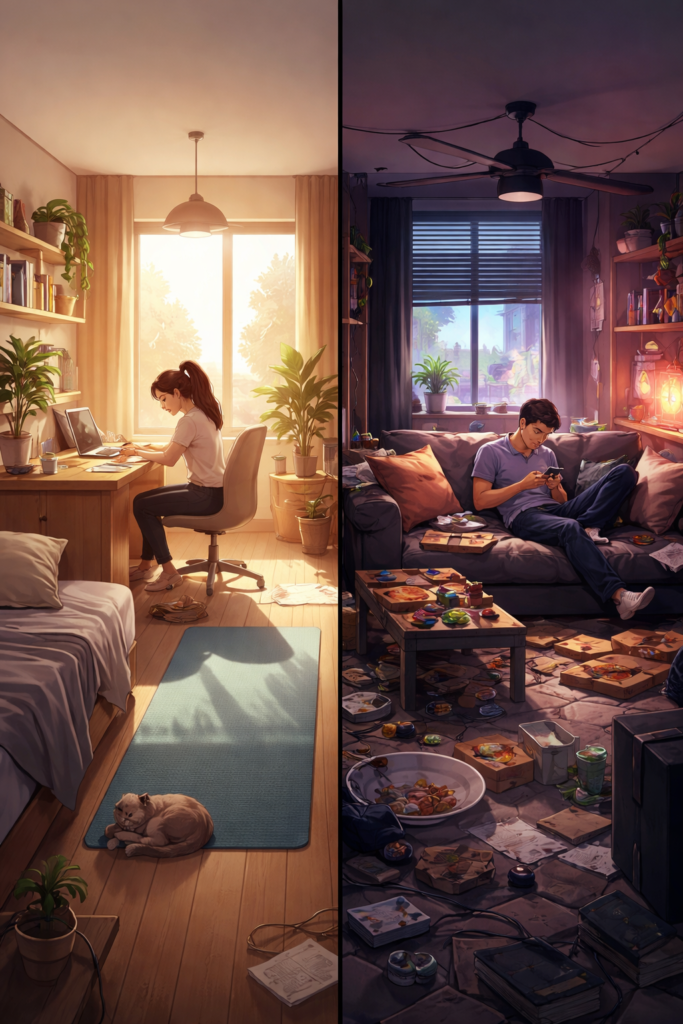
Pause and scan the room you’re in. Does it invite focus—or does it quietly pull your attention in ten directions at once? The emotional tone of a space shapes your behavior before you consciously decide anything. This is the lived reality of environment and habit formation: your rooms carry psychological signals. A cluttered desk can amplify stress and impulsivity, while a structured space can promote calm and intention. When we examine how environment influences habits, we see that discipline is rarely about force—it is about alignment between your goals and your surroundings.
The emotional layer matters because habits are not purely mechanical; they are reinforced by feeling. Among the core characteristics of habit formation are repetition, cue exposure, and emotional reward. If your room makes distraction easy and instantly gratifying, that pattern strengthens. Over time, the role of habit expands beyond behavior and begins shaping emotional resilience. This is why the importance of habit formation is tied directly to the environments you design. Rooms that support clarity foster confidence. Rooms that normalize chaos can reinforce avoidance. The physical becomes psychological.
To redesign for discipline, start with emotional friction. Ask: What emotion does this space trigger most often—focus, boredom, overwhelm, restlessness? Then adjust accordingly. Remove visual clutter that stimulates unnecessary decision-making. Define zones for specific activities so your brain associates location with purpose. Introduce cues that symbolize the person you are becoming—books within reach, tools prepared in advance, distractions out of sight. Small structural shifts create emotional shifts, and emotional shifts reinforce behavioral ones. When your rooms are designed with intention, discipline becomes less about willpower and more about environment working in your favor.
Triggers, Temptations, and Defaults: The Subtle Cues Controlling Your Daily Behavior

Not all decisions feel like decisions. Many of them are responses—automatic reactions to cues embedded in your surroundings. A notification lights up, and your hand reaches for your phone. A snack sits within arm’s reach, and you eat without hunger. These are not moral failures; they are patterned responses to triggers. Temptations are rarely about weakness. They are about exposure. When certain cues appear consistently, your brain learns to respond quickly and efficiently, turning repeated reactions into defaults that feel natural.
Defaults are powerful because they remove negotiation. When a behavior becomes the path of least resistance, it requires almost no mental energy to repeat. Over time, these automatic patterns shape not only what you do, but how you see yourself. If your default is to procrastinate when a task feels overwhelming, you may begin labeling yourself as unfocused. If your default is to act immediately, you may see yourself as disciplined. The cue initiates the behavior, but repetition strengthens the identity behind it. What feels like personality is often simply reinforced exposure.
The strategy, then, is not to fight every temptation head-on, but to redesign the defaults. Make the desired behavior the easiest available option. Place tools for growth in visible, accessible positions. Introduce friction for distractions—log out of apps, move tempting items out of sight, define clear activity zones. Instead of relying on willpower in the moment, prepare your environment in advance. When you shift the cues, you shift the responses. And when the responses change consistently, your daily behavior begins to reflect intention rather than impulse.
Change Your Space, Change Yourself: Reengineering Your Environment for Lasting Growth
Growth becomes sustainable the moment you stop treating your space as background noise and start treating it as behavioral strategy. Every object in your room either reinforces who you’ve been or supports who you’re becoming. Reengineering your environment does not require a dramatic overhaul—it requires intentional editing. Remove what anchors you to distraction. Introduce what invites focus. Position reminders of your goals where your eyes naturally rest. When your surroundings reflect your aspirations, your behavior begins to follow with less resistance.
Lasting change is rarely about intensity; it is about consistency made easier. Think in terms of “behavioral gravity.” What does your space naturally pull you toward? If the couch faces the television and your desk faces a blank wall, one direction is clearly more inviting. Adjust the gravity. Rearrange furniture to signal purpose. Prepare tomorrow’s priorities before you end today. Create visible cues for the habits you want and invisible pathways for the ones you are leaving behind. Subtle structural changes reduce internal conflict because the environment begins working with you instead of against you.
Ultimately, redesigning your space is an act of identity commitment. It signals that growth is not temporary motivation but a sustained direction. When your environment supports clarity, discipline feels lighter. When it supports rest, recovery becomes intentional rather than accidental. Change does not have to be heroic to be powerful—it has to be repeatable. By shaping the physical context around you, you quietly shape the behaviors within you. And when those behaviors align with your desired future, growth stops feeling like effort and starts feeling like alignment.
Conclusion
Your daily behavior is not shaped by willpower alone—it is structured by the spaces you move through every day. The invisible architecture of influence, the emotional tone of your rooms, the triggers and defaults embedded in your surroundings all quietly guide your actions. Whether designed for discipline or distraction, your environment continuously reinforces certain patterns until they feel natural. When left unexamined, these subtle cues decide your direction for you. But when observed intentionally, they reveal powerful leverage points for change.
Lasting growth begins when you stop fighting your habits and start redesigning the context that sustains them. By understanding how cues trigger repetition, how emotional environments influence consistency, and how small structural adjustments shift defaults, you gain practical control over your trajectory. Changing your space becomes more than aesthetic—it becomes strategic. When your environment aligns with your aspirations, your daily choices require less resistance and more alignment. And over time, the quiet psychological forces shaping your behavior begin working in your favor instead of against you.
Leave a Reply